Virtual Systems Integration
Case Study
In this article, we present how MSD SISTEMAS helped a major Aircraft Landing Gear and Brake Systems company to improve their systems with our MSD's VSI toolkit.

Get

Started
Aeronautical Systems Development
Application of MSD's VSI toolkit to model-based development of landing gear and brake systems.

The Challenge
How minimize errors in specifications and improve system performance before the actual system has been built?
Our Solution
Apply MSD's process, tools and engineering expertise to review requirements, create simulation models and tests.
Main Results
More than 100 problems identified and solved, team of engineers trained, integrated model and test cases.
The Challenge
A major Landing Gear and Brake Systems company started a new project of a novel electronic control unit to a part-25 aircraft.
In this project, the Landing Gear Controller and the Brake controller combined have more than 20 high-level functions integrated and implemented as software (anti-skid, autobrake, foot pedal brake …). And it is important to remember that Landing Gear and Brake systems are considered safety-critical, since a failure in one of those systems has a potential safety impact in the whole aircraft.
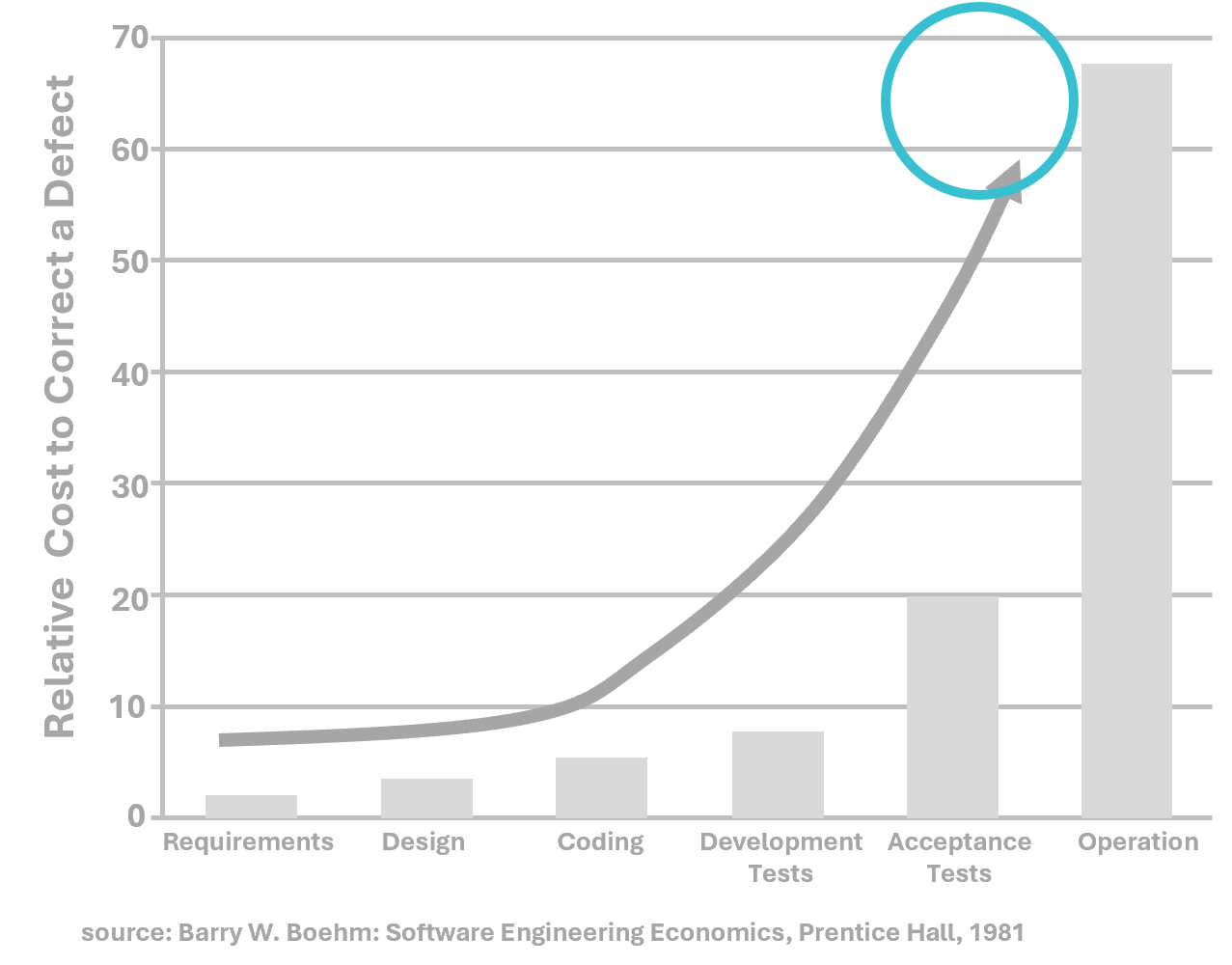
These aspects combined increase dramatically the complexity of the development, increasing significantly the difficulty of specifying state transitions, command and monitoring functions. Furthermore, identifying and correcting a specification error after the start of test campaigns is very costly (about 60x higher than during specification phase).
This way, strategies to minimize errors in specifications and to improve requirements quality are key factors for the success of the program.
Our Solution
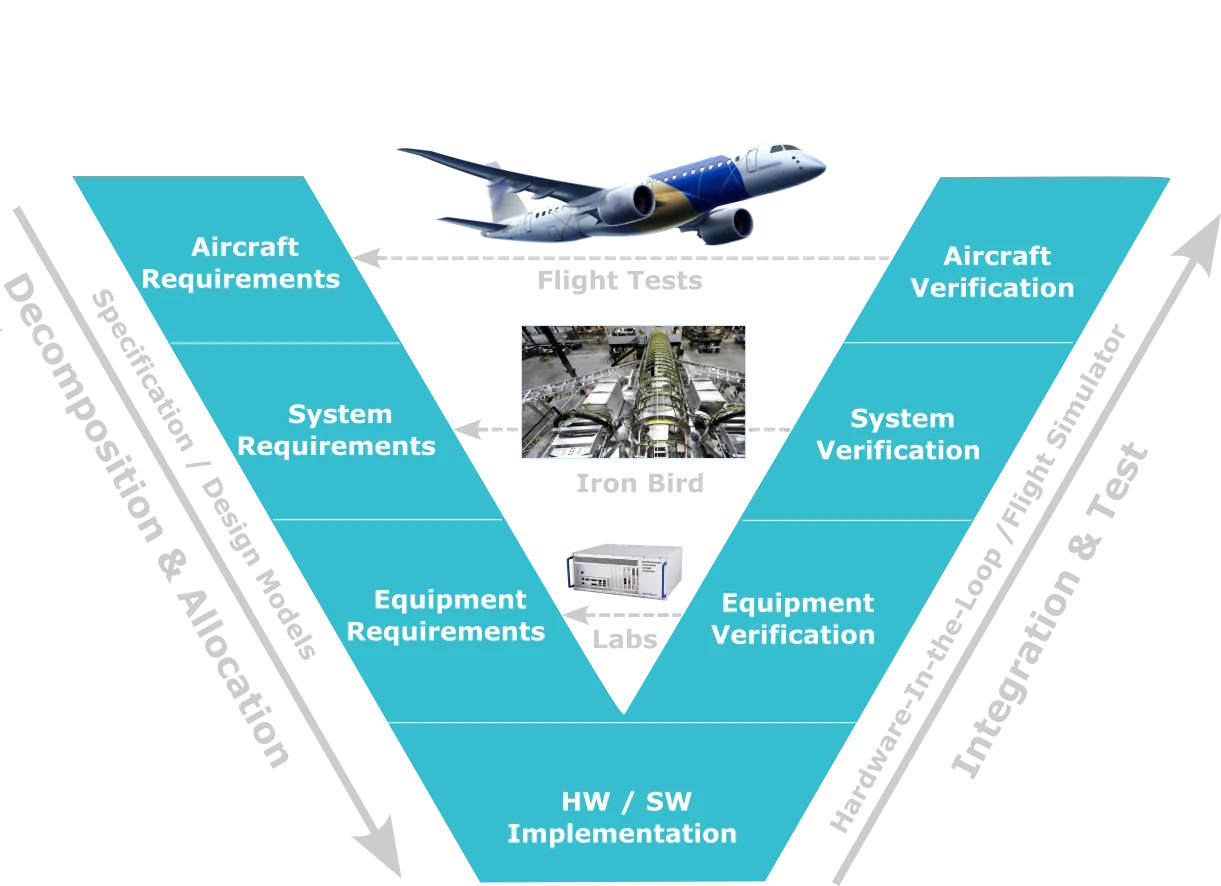
Development of aeronautical systems is one of the most suitable cases for model-based development. Prototypes, test campaigns and certification process are extremely expensive. An error in a requirement committed in early design phases and identified during ground tests can cause huge delays and demand costly modifications. A specification error not identified during ground tests, can appear during flight tests, with potential safety consequences. Long story short, it is a highly integrated safety critical system. There is no room for mistakes.
With this in mind, we deployed MSD’s Virtual Systems Integration toolkit into this project. We started training the client’s engineering team in our model-based process, presenting the process itself as well as best practices summarized in working instructions and guidelines.
The second step was a document review. We analyzed the main documents used in the development such as system requirements, system architecture and system description for example. During this step, we captured the system functions, identified opportunities for enhancements and suggested requirements templates for improving the quality of the specifications.
In the next phase, we started the modeling activities. We defined the architecture for the integrated model, organized the folder structure and version control system. We divided the integrated model into parts that can be worked by each team member in parallel. We also identified reusable components, creating a library of reusable models across the project. The integrated model was organized in such way that we easily generate the code for the application software and for the Hardware-in-loop (HIL).
We also deployed our MSD’s SimStorm Matlab / Simulink toolbox which automated and organized the tests to evaluate the system and integrated models. We raised test scenarios, created test vectors, executed the tests and verified if the simulation results are in accordance with the requirements.
Main Results
We achieved multiple results in different areas, from process improvement to hardware-in-the-loop tests.
During the requirements validation process, we identified opportunities for improvement, creating templates to specify system requirements.
Regarding the modeling activities, we built an integrated closed loop model, implementing system requirements as Matlab / Simulink models.
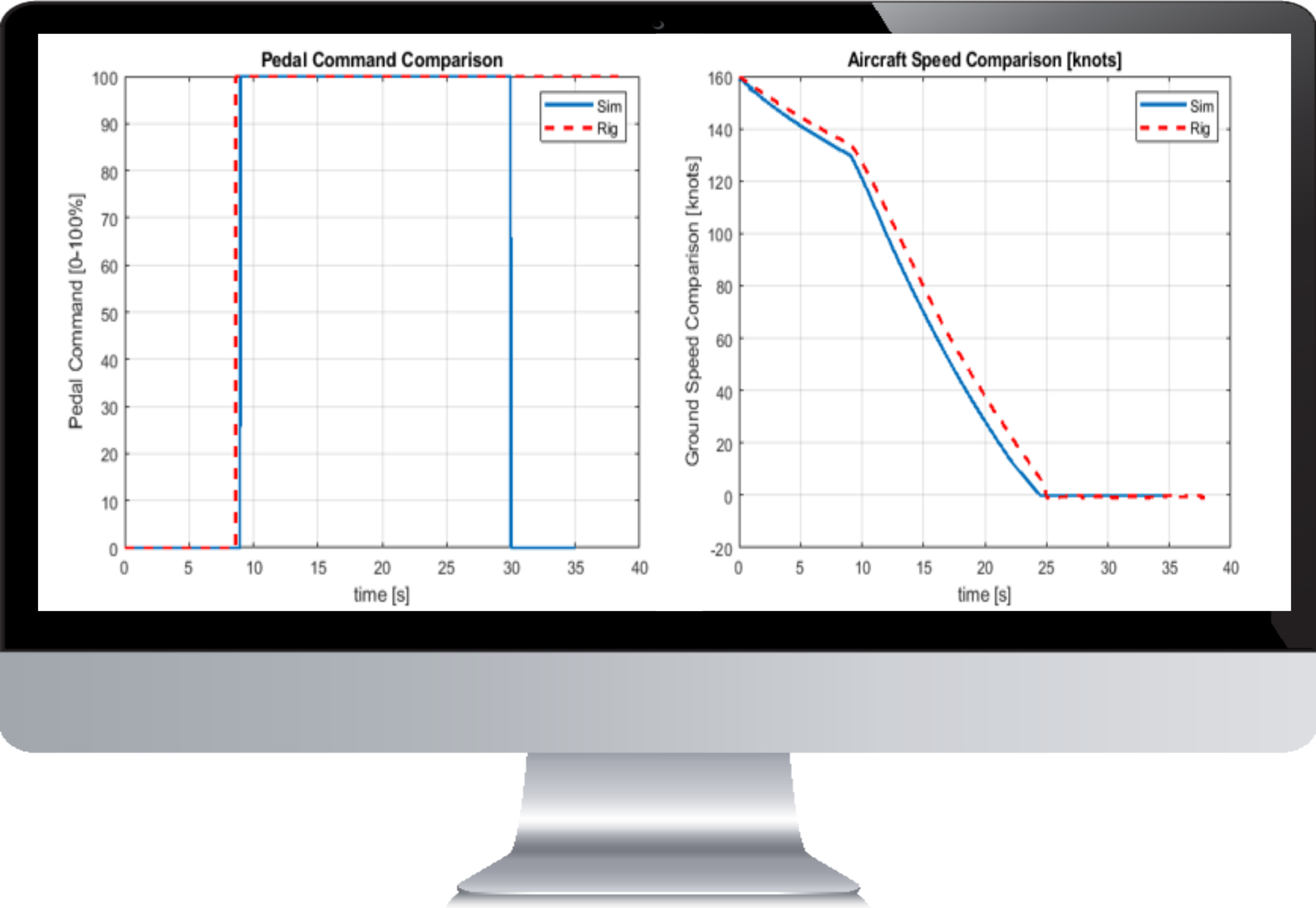
The closed loop model was composed of hydraulics, aircraft, sensors, ground reactions, tire coupling and interactions with the runaway and the controllers with their redundancies and functions implemented as software (signal consolidation, fault management, command and monitoring functions and state transitions). The model architecture was carefully defined in such way that the reusable components were previously identified and modeled as library blocks. This way the client obtained a software modeling library that can be reused for further projects. Another important aspect was the definition of a model architecture that enables automatic code generation for embedded software and HIL purposes. The design models were implemented using the software library which allows automatic code generation for embedded applications. The plant models were also compilable, but for HIL purposes. The comparison between HIL and simulation results can be seen in the figure above.
With the integrated closed loop model available, we started the testing phase. Some initial tests were already performed at the beginning of the modeling activities, where the units’ behavior were evaluated. To analyze the integrated system behavior, we anticipated some testing scenarios that would be used during the real system verification phase.
Throughout the whole development we used MSD’s SimStorm Matlab/ Simulink toolbox to automate modeling and testing activities, which reduce the amount of time required to model and test the system. When we are dealing with large scale simulation, connecting the subsystems interfaces and buses become extremely time-consuming. For example, some subsystems had more than 100 inputs and outputs, and in these cases the automation provided by our toolbox really speeds up the process. Another benefit was the automation of test execution with automated verification of results, which enabled a quick identification of unexpected system behaviors.
The Landing Gear and Brake systems team was trained in the MSD’s model-based development process, being able to maintain and extend the models by themselves. We shared our training material with working instructions and guidelines in such way that they can multiplicate the knowledge inside the company. And most important, they learned how to use the models to obtain useful results, identifying issues, solving them and improving the system design.
Finally, applying MSD’s VSI toolkit, it was identified more than 100 (one hundred) issues. These issues were solved, improving the requirements and the real system design, before the real controller has been implemented, helping our client to meet their schedule and budget.
Let's keep in touch!
If you would like to learn more about our products and services, feel free to contact us anytime.