SimStorm Resource Allocation
Case Study

In this article, we present how MSD SISTEMAS helped a major global audit and advisory firm automate the planning and allocation of its workforce with SimStorm Resource Allocation.

Resource Planning and Allocation
Application of SimStorm Resource Allocation to distribute work requests among the professionals of an audit and advisory operation.
Get Started
The Challenge
How can the right professional be assigned to each request, in compliance with independence, training and availability rules, without relying on spreadsheets and manual checks?
Our Solution
Integrate the client’s systems into a web platform that automatically verifies the business rules and presents only the eligible professionals.
Main Results
Business rules verified by the system, centralized and up-to-date data, visual team planning and reports generated in a few clicks. Reduced workload spent on repetitive tasks.
The Challenge
A major global audit and advisory firm maintains a dedicated team responsible for allocating work requests that are executed by different teams. Each request arrives with a client, a service type, a due date and an estimate of hours, and must be assigned to one or more professionals.
In addition to availability, each assignment must comply with a set of rules. Independence standards prevent professionals from working for clients with whom they have any relationship, and there are restrictions for those already serving competing companies. Each service type requires specific training, and the review of work follows hierarchy rules: the professional who reviews a deliverable must have a higher seniority level than the professional who performed the task.
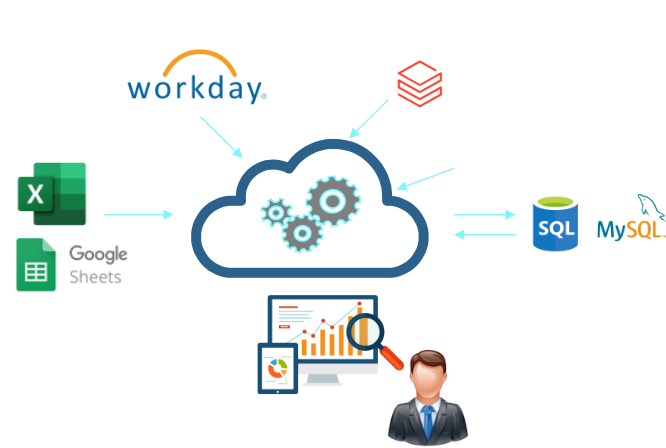
The information required for this decision was spread across different systems: the work request system, the ERP, the human resources platform holding the training records of each professional, and the vacation and leave management system. To allocate a single request, the resource manager had to query each of these sources, cross-reference the data in spreadsheets and check the rules manually. The process was slow, depended on the knowledge of a few people and was prone to errors.
Moreover, the allocations made by this team are audited periodically, and an incorrect allocation can have serious consequences, leading to rework and financial penalties. An independence conflict compromises the firm’s compliance, while limited visibility into team capacity leaves some professionals overloaded and others with idle capacity (unallocated hours during the week).
Given this scenario, the client needed a tool that would consolidate the information in a single place, apply the business rules automatically and clearly show the team’s demand and capacity, as well as generate auditable reports of the allocations performed.
Our Solution
Resource allocation at an audit firm is a typical case of a well-defined process with clear business rules, in which the volume of data makes manual operation highly inefficient. Information on vacations, training and other restrictions, as well as the requests themselves, changes frequently. This called for a system capable of integrating multiple tools and automating the execution of the process.
With this in mind, we deployed SimStorm Resource Allocation in this project. We started by mapping the allocation process together with the client’s teams: how requests were received, who took part in the decision and which rules were applied at each step. This assessment resulted in a formal list of business rules, validated with the responsible departments.
Next, we integrated the platform with the systems already in use at the firm. SimStorm began reading the work requests, the professionals’ master data, client and economic group information from the ERP, as well as vacation and leave records. Synchronization is performed automatically through communication APIs between SimStorm and the client’s tools, and if a request does not appear on the platform, the manager can force an update by entering its number.
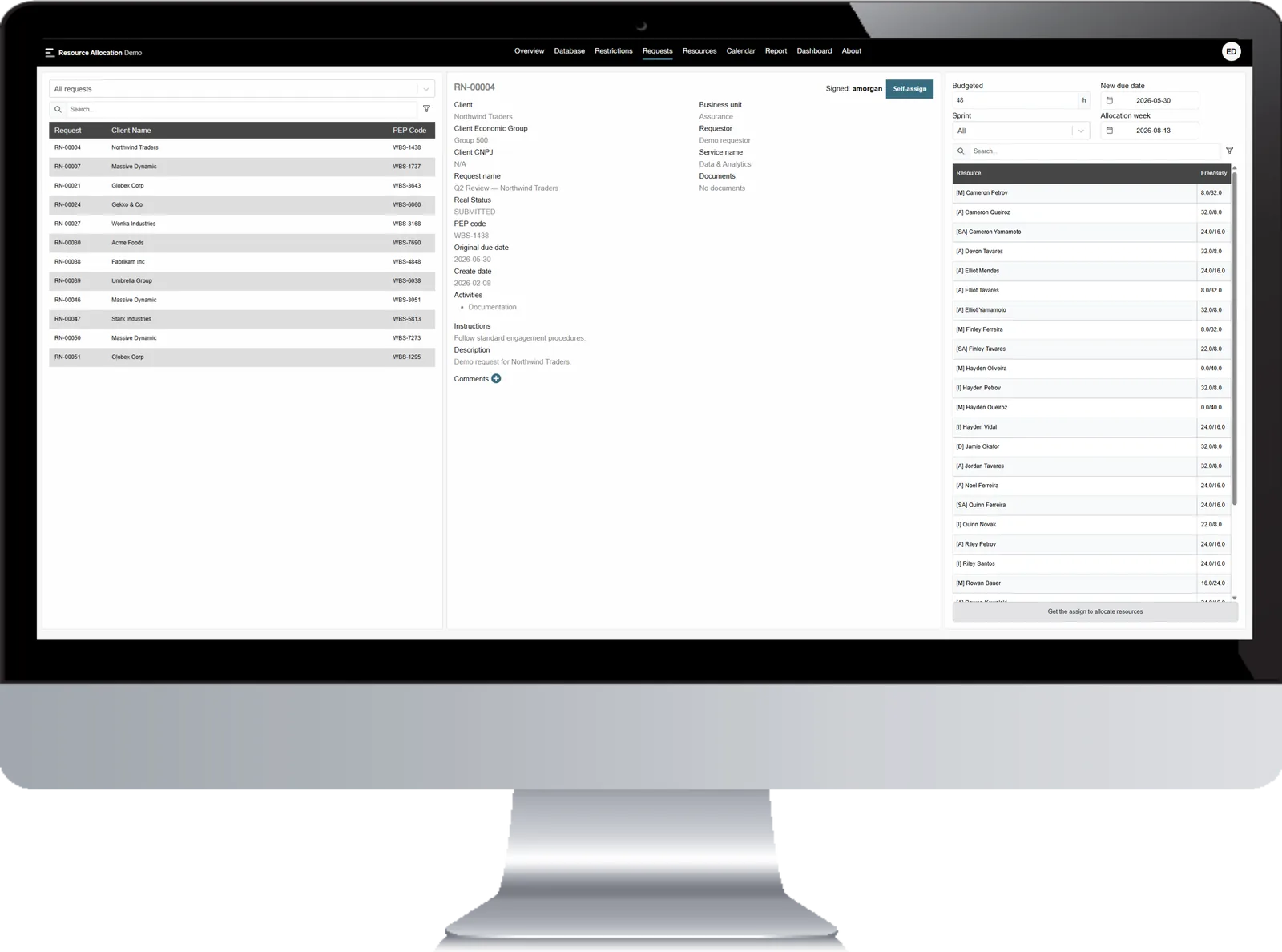
With the data consolidated, we implemented the rule verification engine. For each request, the system evaluates the team’s professionals and shows who is eligible to take it on. For those who are not, the screen displays the reason for the restriction. The criteria verified include:
- vacations and leave during the request period;
- independence restrictions regarding the client and its economic group;
- restrictions due to work for competing clients;
- training required for the requested service type;
- available weekly hours compared with allocated hours;
- the professional’s eligibility to receive requests and hierarchy rules (comparison between the seniority levels of performers and reviewers).
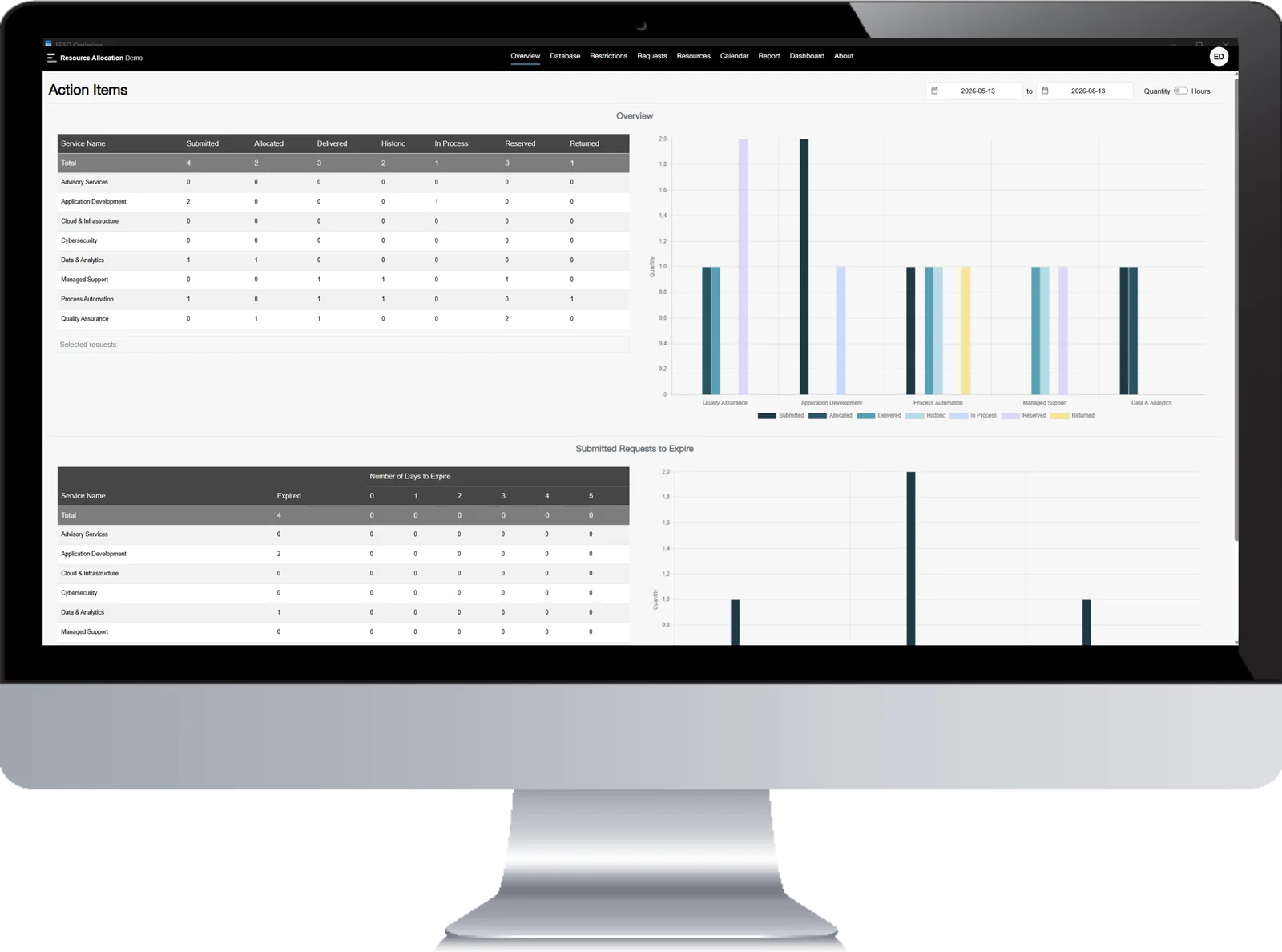
The platform is organized into two access profiles. The resource manager has a dashboard with the key indicators, the list of requests and their status, an allocation screen with the weekly distribution of hours and a Gantt chart planner showing each professional’s activities. Team members access their own tasks and deadlines, view the details of each request and record absences directly in the system.
We also developed a set of reports that can be exported to Excel, covering allocations, activities, the list of professionals, vacations and leave, professionals with independence, competitor or training restrictions, and the system usage logs, in order to facilitate audit procedures.
Main Results
The results span several areas, from the quality of the allocations to the time the manager dedicates to planning.
The automatic verification of business rules ensures that each request is assigned only to eligible professionals. Independence, competitor and training restrictions, which previously depended on manual queries, are checked by the system at the time of allocation, and the reason for each block is displayed on screen. This reduces the risk of conflicts and makes the process traceable for the compliance teams.
With integrated data, the manager no longer needs to build spreadsheets to cross-reference information. Requests, professionals, vacations and restrictions are updated automatically, and allocation decisions are based on current data.
The indicators dashboard and the Gantt planner provided visibility into the team’s capacity and demand. It became easier to identify who is overloaded or has available hours, to track requests that are close to or past their due date, and to redistribute work before a delay occurs.
Team members now track their tasks and record absences on their own, which keeps the plan up to date without relying on parallel messages and emails. The exportable reports serve both management and the compliance teams, who obtain lists of allocations and restrictions in a few clicks.
In numbers, the time required to perform each allocation was reduced by more than 80%. As a result, the productivity of the allocation team increased significantly, with less effort spent on repetitive tasks. The time saved allowed part of the team to be reassigned to higher value-added activities. Instead of performing repetitive and highly error-prone tasks, the team became the guardian of the process, ensuring, with the support of the tools, that it is executed optimally.
Finally, since the solution was built on SimStorm, new rules, data sources and reports can be added as the client’s process evolves, without the need for a new system.
Let's keep in touch!
If you would like to learn more about our products and services, or to request a demo of SimStorm Resource Allocation, feel free to contact us anytime.